There is something unusual about the way ceremonial matcha is grown.
Several weeks before harvest, farmers cover the tea plants completely. They block out the sun. They plunge the fields into shade.
And something remarkable happens.
Understanding why matcha is grown in the dark explains almost everything about why good matcha tastes the way it does — smooth, naturally sweet, rich with umami — and why most matcha you have tried before probably didn’t.
What shade growing actually does to the tea plant
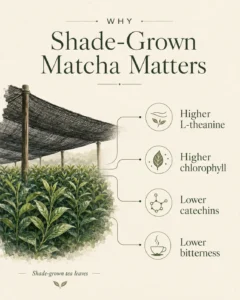
A tea plant’s natural instinct, like any plant, is to photosynthesise. To convert sunlight into energy. In doing so, it draws an amino acid called L-theanine up through its roots and converts it into catechins — the compounds responsible for bitterness and astringency in green tea.
When a farmer covers the plants and blocks the sunlight, that conversion stops.
The plant can no longer photosynthesise efficiently. So instead of converting L-theanine into catechins, it holds onto it. The amino acid accumulates in the leaf. The bitterness stays low. The sweetness and umami stay high.
At the same time, the plant works harder to absorb whatever light remains. It produces more chlorophyll – the pigment responsible for the vivid, electric green colour of high quality matcha. The deeper the green, the more carefully the plant has been shaded.
A 2021 study published in PMC confirmed that shade growing significantly increases chlorophyll and theanine content while reducing the catechins responsible for bitterness. The science supports what Japanese tea farmers discovered centuries ago by observation alone.
How long does the shading last

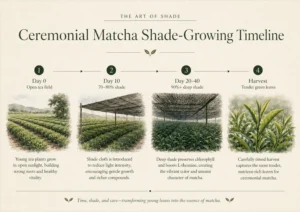
The shading period for ceremonial matcha typically lasts between 20 and 40 days before harvest. Some premium producers shade for longer.
The process happens in two stages. In the first stage, farmers reduce sunlight by around 70 to 80 percent using shading materials stretched across the fields. About ten days in, they reduce it further – sometimes to 90 percent or more.
As the plants strain for the remaining light, they grow differently. The leaves become wider and thinner, reaching outward. More tender. More palatable. The concentration of L-theanine continues to build.
Traditionally, dense bamboo reed screens were used to create the shade. Today most farms use purpose-built tarpaulins suspended on metal poles across entire fields. Installing this infrastructure can cost hundreds of thousands of dollars — one reason why genuinely shade-grown ceremonial matcha commands a premium over sun-grown alternatives.
Why this is what separates ceremonial matcha from everything else
Not all matcha is shade grown. Culinary-grade matcha, designed for lattes and baking, is often made from sun-grown leaves. The catechins are higher. The L-theanine is lower. The bitterness is more pronounced — which is fine when the matcha is mixed with milk and sweetener, but noticeable when drunk with water alone.
True ceremonial-grade matcha requires shade growing. It is not optional. Without it, the L-theanine levels are insufficient to produce the smooth, umami-forward flavour that defines the ceremonial experience.
This is also why colour matters when choosing matcha. A vivid, deeply saturated green signals high chlorophyll — which signals careful shade growing. A dull, yellowish or khaki-toned powder signals the opposite.
For a full guide on what to look for when choosing matcha, our post on buying matcha in Australia covers the key differences in detail.
The calm energy connection
L-theanine does more than affect flavour. It is the compound responsible for the distinctive feeling of drinking ceremonial matcha – focused, alert, and calm at the same time.
In sunlight, L-theanine is converted into catechins before the leaf is harvested. The shade growing process preserves it. A ceremonial-grade matcha prepared from properly shaded leaves contains significantly more L-theanine than any sun-grown alternative – and considerably more than regular green tea.
L-theanine works in combination with caffeine to produce what researchers describe as a state of calm alertness. The caffeine sharpens focus. The L-theanine smooths the edges – no spike, no crash, no anxiety.
A review published in PubMed found that L-theanine alone improved self-reported relaxation and calmness. The combination of L-theanine and caffeine — exactly what shade-grown matcha delivers – is associated with improved attention and cognitive performance.
Coffee sharpens. Matcha steadies. The shade growing process is a large part of why.
What this means for Nami and Goku
Both Nami and Goku are grown using traditional shade cultivation by the Harima family in Ujitawara, Kyoto Prefecture — the birthplace of Japanese green tea. The same unhurried approach. The same careful shading. The same patient farming that has been practiced on that land for over 50 years without pesticides or synthetic fertiliser.
The difference between them is in the grade.
Nami is our everyday ceremonial matcha. Lighter in body with a gentle natural sweetness. A beautiful morning cup prepared with water, and equally good in lattes.
Goku is our finest grade. The shade growing has done more of its work here. Smoother, richer, more umami-forward, with a natural sweetness that needs nothing added. If you want to understand what ceremonial matcha is truly capable of – prepared slowly, with water only – Goku is where that answer lives.
Both will taste different from most matcha you have tried before. The shade growing process, done carefully and without shortcuts, makes that difference visible in the cup.
A practice discovered by accident
There is one more thing worth knowing about why matcha is grown in the dark.
The shading technique was not designed. It was discovered.
Centuries ago, Japanese farmers began covering their tea plants with bamboo mats to protect them from late spring frosts. When they harvested those leaves, they noticed something unexpected. The flavour was different. Sweeter. Less bitter. More layered.
They did not know the science. They did not know about L-theanine or chlorophyll or catechins. They simply noticed that the covered plants tasted better – and kept doing it.
What began as protection became craft. What became craft became ceremony. What became ceremony is now in your bowl every morning.
That is the quiet history behind every cup of ceremonial matcha that tastes the way it should.