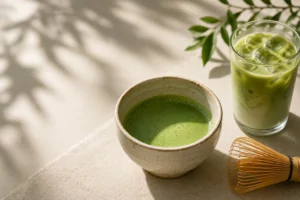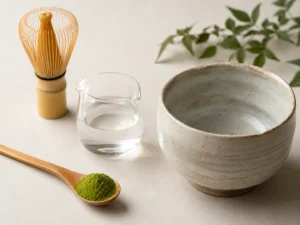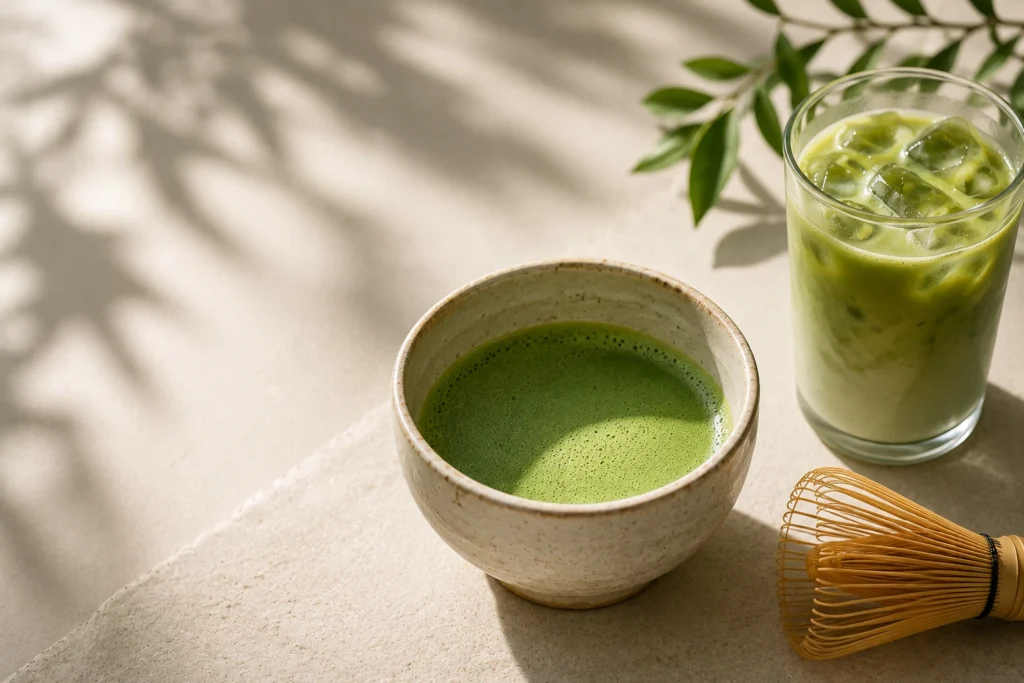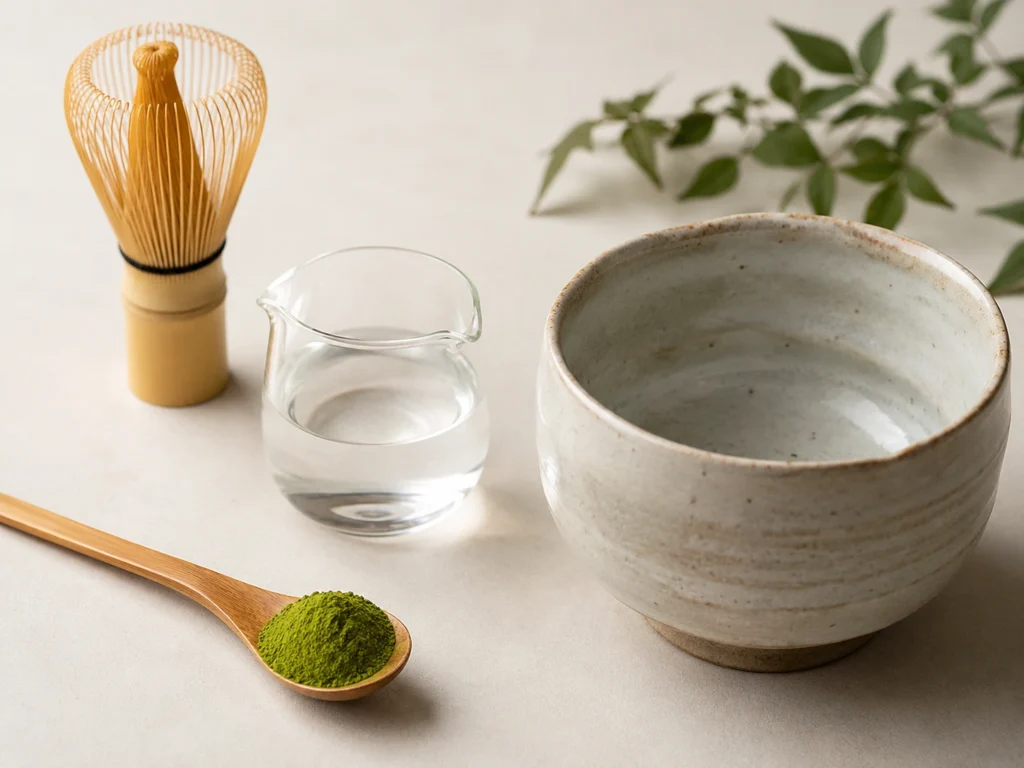
In short: ceremonial matcha is high-grade, shade-grown Japanese green tea powder, stone-ground from the youngest tea leaves and made to be whisked with water and drunk as it is. It is the grade made for daily ritual, not for cooking, and the quality comes from how carefully the leaf is grown, harvested, and milled.
If you’ve ever wondered what is ceremonial matcha – truly, beyond the powder and the whisk – start here.
Ceremonial matcha is the highest grade of Japanese green tea powder, grown specifically for drinking rather than cooking.
The tea plants are shade-grown for around three to four weeks before harvest, which deepens the chlorophyll, boosts the L-theanine content, and produces that distinctive vivid green colour.
After harvest, the leaves are steamed, dried, and stone-ground into an ultra-fine powder – slowly, so the heat doesn’t damage the flavour.
What makes it ceremonial is both the quality of the leaf and the intention behind it.
It comes from the youngest, most tender leaves at the top of the plant.
It contains no stems, no veins. The flavour is smooth and naturally sweet, with a depth that lower grades simply don’t have.
It’s meant to be whisked with water and drunk as it is – nothing added, nothing hidden.
That’s the simple answer.
But ceremonial matcha is not only about leaves.
It comes from a philosophy.
A way of approaching the moment.
Below are seven essential truths drawn from traditional Japanese tea practice – and a deeper answer to what ceremonial matcha actually is.
Not rules.
Orientations.
New to this? Nami 50g is our everyday ceremonial matcha, built for exactly this kind of daily ritual.
1. Harmony (Wa) – Nothing Is Separate
Harmony is the first principle of tea.
It is not symmetry. It is attunement.
A tea master was once asked how to host well.
He answered simply:
“In summer, suggest coolness. In winter, suggest warmth.”
Prepare before the guest arrives. Anticipate rain. Consider everything.
Harmony is not about impressing.
It is about sensing.
The season. The room. The other person.
Ceremonial matcha carries this same spirit. The bowl you choose matters. The light in the room matters. Your state matters.
The ritual is not separate from your life.
It belongs to it.

Learn more about the origins of Japanese tea ceremony at the Urasenke Foundation – one of the oldest schools of chado still active today.
2. Respect (Kei) – Attention Is Devotion
Respect in tea is quiet.
It is shown through care. Through preparation. Through presence.
There is a story of a samurai who entered the tearoom with his sword.
The tea master asked him to leave it outside.
Not to diminish him. But to protect the space.
In the tearoom, there is no rank. No armour. No status.
Only human presence.
Respect removes hierarchy.
It creates equality.
When you prepare ceremonial matcha, you measure gently. You whisk without rush.
You are not performing wellness. You are not optimising.
You are tending.
Respect begins with how you hold the bowl.
It continues with how you receive the moment.
3. Purity (Sei) – Clear the Noise
Purity in tea ceremony does not mean perfection.
It means clearing.
Before entering the tea room, guests walk through a small garden.
The path is quiet. Often moss-lined. Unadorned.
Along the way sits a low stone basin filled with water.
Each guest pauses.
They rinse their hands. They rinse their mouth.
Not because they are unclean.
But because something must be left behind.
Dust. Conversation. Status. Noise.
The act is small.
The meaning is large.
You enter lighter than you arrived.
The tools inside the tea room are also rinsed. The bowl is wiped. The whisk is cleansed. The cloth is folded carefully.
Not for display.
For clarity.
Purity is not sterility.
It is intentional simplicity.
When you prepare ceremonial matcha, the same soft clearing happens. The kettle warms. The powder is sifted. Water meets leaf.
Before the first sip, something shifts.
The mind settles.
Not through force. Through repetition.
Through reducing what is unnecessary.
Ceremonial matcha does not fix the day.
It clears space within it.
Noise recedes.
Not because life is silent.
But because you have stepped, briefly, into the garden.
For the exact method, read our step-by-step guide on how to prepare ceremonial matcha.
4. Tranquility (Jaku) – Calm Is Strength
Tranquility is the fourth principle of tea.
It is not passivity.
It is grounded composure.
There is a story of a scholar who visited a Zen teacher.
The teacher poured tea.
He kept pouring.
The cup filled. Then overflowed.
The scholar objected.
“It is full. No more will fit.”
The teacher replied:
“You are like this cup.”
Tranquility begins with emptying.
Not with adding.
In tea ceremony, the movements are unhurried.
Measured. Economical.
Nothing extra.
Nothing dramatic.
The stillness is deliberate.
Ceremonial matcha supports this same state. The L-theanine in ceremonial-grade matcha works in quiet partnership with its natural caffeine – energy rises slowly, steadily. There is clarity without sharpness. Alertness without agitation.
This is part of what makes ceremonial matcha different from a coffee or even a lesser-grade tea. The quality of attention it invites is its own.
Calm becomes strength.
Not urgency.
Not force.
A steady interior.
Tranquility is not the absence of activity.
It is the absence of excess.
When you drink ceremonial matcha, you are not amplifying yourself.
You are clearing space.
So what remains can stand firmly.

The science behind L-theanine and calm focus is well documented. Healthline’s overview of matcha’s health benefits is a good starting point if you’re curious about what’s actually happening in the body.
5. Wabi-Sabi – Imperfection Is Enough
Traditional tea bowls are often asymmetrical.
Uneven glaze. Irregular form. A lip that does not meet perfectly.
This is intentional.
There is a story of a tea master who asked his son to prepare the garden for guests.
The son swept the path carefully. Removed every fallen leaf. Smoothed the gravel.
Everything was orderly.
The tea master looked at the garden.
Then he walked to a tree and shook it gently.
A few leaves drifted down onto the path.
“Now,” he said, “it is ready.”
Beauty lives in what is alive.
Not what is controlled.
Wabi-sabi honours what is weathered. What is handmade. What carries time within it.
A tea bowl may show cracks in the glaze. Subtle variations in colour. Marks from the kiln.
These are not flaws.
They are evidence.
When you whisk ceremonial matcha, the foam may not be flawless. It may not rise evenly. The surface may settle quickly.
It does not need to be perfect.
The ritual is not about getting it right.
It is about showing up.
Returning.
Allowing small inconsistencies.
Allowing yourself to be unfinished.
Wabi-sabi reminds us: imperfection is not a problem to correct. It is a sign of presence.
And presence is enough.
Curious how the grades differ? Read our guide to how to tell if matcha is high quality, or go straight to Goku if you are ready for a more refined ceremonial upgrade.
6. Ichigo Ichie – This Moment Will Not Repeat
In tea philosophy, there is a phrase:
Ichigo Ichie.
One time. One meeting.
It reminds host and guest that this gathering – exactly as it is – will never occur again.
The same people may meet next week. The same bowl may be used.
But the season will have shifted. The light will be different. Something subtle will have changed.
A tea master once wrote that each encounter should be treated as if it were both the first and the last.
Not dramatically.
Simply attentively.
Another story tells of a host who worried his gathering was too plain.
The flowers were minimal. The utensils simple.
A guest reassured him:
“This meeting will not repeat. It is already complete.”
Nothing more was required.
Ichigo Ichie does not create pressure.
It softens it.
It asks only that you notice.
Ceremonial matcha becomes meaningful through repetition. Yet each cup is singular.
The water temperature shifts slightly. The foam settles differently. Your mood is not identical to yesterday.
Drunk today. Not yesterday. Not tomorrow.
This is what ceremonial matcha quietly teaches – not through instruction, but through the act itself.
You do not rush what cannot return.
You do not demand perfection from what is fleeting.
You meet it.
Fully.
And then you let it pass.

The philosophy of Ichigo Ichie is explored beautifully in Héctor García and Francesc Miralles’ book Ichigo Ichie: The Japanese Art of Living Every Moment – worth reading slowly, in the same spirit it describes.
7. Presence Over Performance
The tea ceremony is not about teaching.
It is not about demonstrating expertise.
There is a story of a guest who attended a gathering hosted by Sen no Rikyū.
Afterward, someone asked what wisdom had been shared.
What philosophy had been explained.
Rikyū answered simply:
“I prepared tea.”
Nothing more.
In the tearoom, there is no need to prove understanding.
No need to instruct.
The host prepares. The guest receives.
Meaning is not announced.
It emerges.
The movements are precise, but never theatrical.
The silence is intentional, but never heavy.
Nothing is explained excessively.
Ceremonial matcha carries this same spirit.
You do not need to master history. You do not need perfect foam.
There is one essential step.
Attention.
When you sift the powder, be there. When you whisk, be there. When you drink, be there.
Not optimisation. Not enhancement.
Presence.
The strength of the ritual is not in how well it is performed.
It is in how fully it is inhabited.
And that requires nothing more than your willingness to arrive.
So, What Is Ceremonial Matcha?
It is shade-grown Japanese green tea powder.
Yes.
Grown slowly beneath covered fields. Stone-ground with care. Prepared with water alone.
But what is ceremonial matcha, really?
It is a daily structure for steadiness.
A small architecture for the morning.
A ritual of harmony. Respect. Purity. Tranquility.
It asks you to notice the room. To soften your grip. To clear what is unnecessary.
It reminds you that imperfection is natural. That this cup will not repeat. That nothing needs to be performed.
Ceremonial matcha does not promise transformation.
It offers orientation.
A turning toward what is already here.
It does not demand improvement.
Only participation.
Only that you arrive as you are.
The water warms. The powder settles into the bowl. The whisk moves in quiet circles.
There is no audience.
No optimisation.
Just a small, deliberate act that steadies the nervous system and gathers the morning into something contained.
Prepared slowly. Drunk quietly.
Not to become someone else.
But to return.
Ready to begin? Browse our range of ceremonial grade matcha – single origin, stone ground, sourced with care from Japan’s finest growing regions.
Frequently asked questions
What is ceremonial matcha exactly?
Ceremonial matcha is the highest grade of Japanese green tea powder, made from the youngest shade-grown leaves and stone-ground into an ultra-fine powder. It is made to be whisked with water and drunk as it is, rather than mixed into recipes or lattes.
How is ceremonial matcha different from culinary matcha?
Ceremonial matcha is finer, smoother, and more refined, intended for drinking straight with water. Culinary matcha is stronger and more robust, suited to baking, smoothies, and recipes where it needs to hold its flavour through other ingredients.
Where does the best ceremonial matcha come from?
Uji, in Kyoto, is one of Japan’s most respected regions for ceremonial matcha, though Nishio, Yame, Shizuoka, and Kagoshima are also important Japanese tea-growing regions. Origin is a strong quality signal, alongside freshness, milling, and storage.
Is ceremonial matcha just a marketing term?
“Ceremonial” is not a tightly regulated legal term, so it should not be judged on the label alone. A genuine ceremonial matcha should look vivid, smell fresh, feel fine in texture, and taste smooth and balanced with water.
Can I use ceremonial matcha for a latte?
Yes. Ceremonial matcha can make a smooth, premium latte. Nami is a good everyday choice for this because it remains balanced with milk while still being suited to drinking with water alone.
Where should I buy ceremonial matcha in Australia?
Look for a brand that is transparent about origin, grade, and freshness. Our guide to buying matcha in Australia covers what to check before you choose.
Begin with the bowl
What is ceremonial matcha, in the end? A daily ritual, prepared simply, returned to often.
What changed and why
Title/H1: replaced the “7 Essential Truths” framing with the brief’s preferred format (“A Simple Guide to Taste, Quality, and Daily Ritual”), matching the title pattern already used across the other optimised pages in this cluster for consistency. Quick answer: 56 words, placed directly above the existing opening paragraph, so the seven-principles narrative begins exactly as it did before. Soft mid-page CTA: added after the intro (Nami for beginners) and a second light touch after Wabi-Sabi (Goku as upgrade) — this satisfies the “use the product bridge naturally” instruction without interrupting the parable structure, since both sit in natural pause points between sections rather than inside them. Strong end CTA: replaced the existing closing line with one that echoes the keyword one final time, paired with the Nami button — previously there was no distinct end CTA, just the “Ready to begin?” line, which is preserved above it. Internal links added: How to Prepare Ceremonial Matcha (section 3), How to Tell If Matcha Is High Quality + Goku (section 5), Buy Matcha Australia (new FAQ), Nami (CTA). That’s 5 contextual additions, within your 5-8 range. FAQ: entirely new 6-question block, covering definition, ceremonial vs culinary, origin, label-trust, latte use, and where-to-buy — matches search intent without duplicating the philosophical body content. All seven principles, every parable, every Healthline/Urasenke/Ichigo-Ichie citation, and the closing meditation are completely untouched, per your instruction to leave the existing content as-is.